Sunday, July 31, 2011

Collares Rojos

When I moved to Bayahibe in April, I started walking Rosalinda every morning with a lady named Yanela who has six dogs. I learned more and more about a local foundation called “Collares Rojos” or Red Collars, of which Yanela is the director. It is a non-profit organization working to help abused and abandoned dogs and street dogs. Their main mission is to fix all the street dogs so that the dogs are less aggressive and, of course, cannot reproduce. However, they also look after street dogs that have been in an accident (get hit by a car, etc.), and try to get dogs adopted. Here there are not very many laws against dog abuse, and Dominicans, in general, have a bad attitude against dogs. For example: when I adopted Rosalinda, she would bark at children because the kids in the neighborhood where she was born would throw rocks at her.

When I lived in Mano Juan, the community always complained about how the dogs were a huge problem because they always bothered the tourists. In an effort to help, in May I worked with Collares Rojos to get three veterinarians to go out to Mano Juan and fix the street dogs there. There were four dogs already pregnant, so they planned to go out a couple of months later to finish the job.

A couple of weeks ago the new volunteer in Mano Juan, who had just gotten back from a trip, called me and said that she could not her dog, Mandy, and was worried about her. Later that day, I was walking down the street and ran into my friend that works with a tourist company that goes to Mano Juan. He said that that day when they went, a community member had met him on the beach and told him that they had taken care of the dog problem for the tourist companies. They had killed eight dogs the day before. My friend and all of the other workers were furious; they had not wanted this to happen.
I called the volunteer in Mano Juan back to confirm her worries; Mandy was dead.

The order to kill the dogs had come through a community member who had just become the local governmental official. However, there is a law against killing dogs in such a way so Collares Rojos and the tourist companies that go to Mano Juan were very upset and the whole town of Bayahibe was talking about the incident for several days.

Now the community members of Mano Juan understand what they did was wrong but the incident still has a lasting effect. One of the dogs they killed had eight puppies. Four of the puppies have died, one the volunteer at Mano Juan adopted, and three are awaiting adoption at Collares Rojos.

Since this incident, I started volunteering at the Collares Rojos’ new pound where they have abused and abandoned puppies and dogs awaiting adoption. There are always going to be bad stories like this but they don’t have to end there because there will also always be individuals that strive to make a difference. If anyone would still like to donate to one of my projects, please donate to this one! The foundation is always looking for money for dog-food and medicine. You can donate at collaresrojos.org; be sure to say that you know me!

Collares Rojos' pound:


Puppies at pound:


***When I was on vacation in June, Rosalinda got out of the yard and was hit by a car. A friend of Yanela’s saw Rosa and called Yanela. When Yanela recognized that it was my dog, she took her straight to the vet in La Romana. Rosalinda had a broken rib, bruised jaw, and a dislocated shoulder. Now she will always have a limp, but she is alive. A special thank you to Yanela and Santiago for taking such good care of her!

Sunday, June 26, 2011

Summer Vacation

At the beginning of July, I went on vacation to Boston and New York City, and then I spent a week home in Texas. I left Santo Domingo 3am on May 31st and arrived in Boston at 9am. Katie Apone, a friend from my Peace Corps group who wasn’t crazy enough to extend had returned home there and so I went for a couple of days to visit her.

It was quite strange being with another Peace Corps volunteer in the states. Especially when we went to WalMart and she drove. What? You mean that we don’t have to wait for the public guagua (bus) and drive through crazy, noisy traffic for a half an hour longer than it should be to get to the supermercado and then take all our bags back on the crowded, hot guagua back to site? Weird!

We had a great time…we walked all over Boston, I learned the train system (which helped out a lot in NYC), we had a picnic in the park, took a tour around Harvard University, and went to a Boston Improv show.

Next, I took a bus through Connecticut to NYC to meet with my sister, Liz, for five days. We got to see all of the touristy sites including…


Central Park which was beautiful and so weird because it’s a HUGE park stuck in one of biggest cities.


Times Square


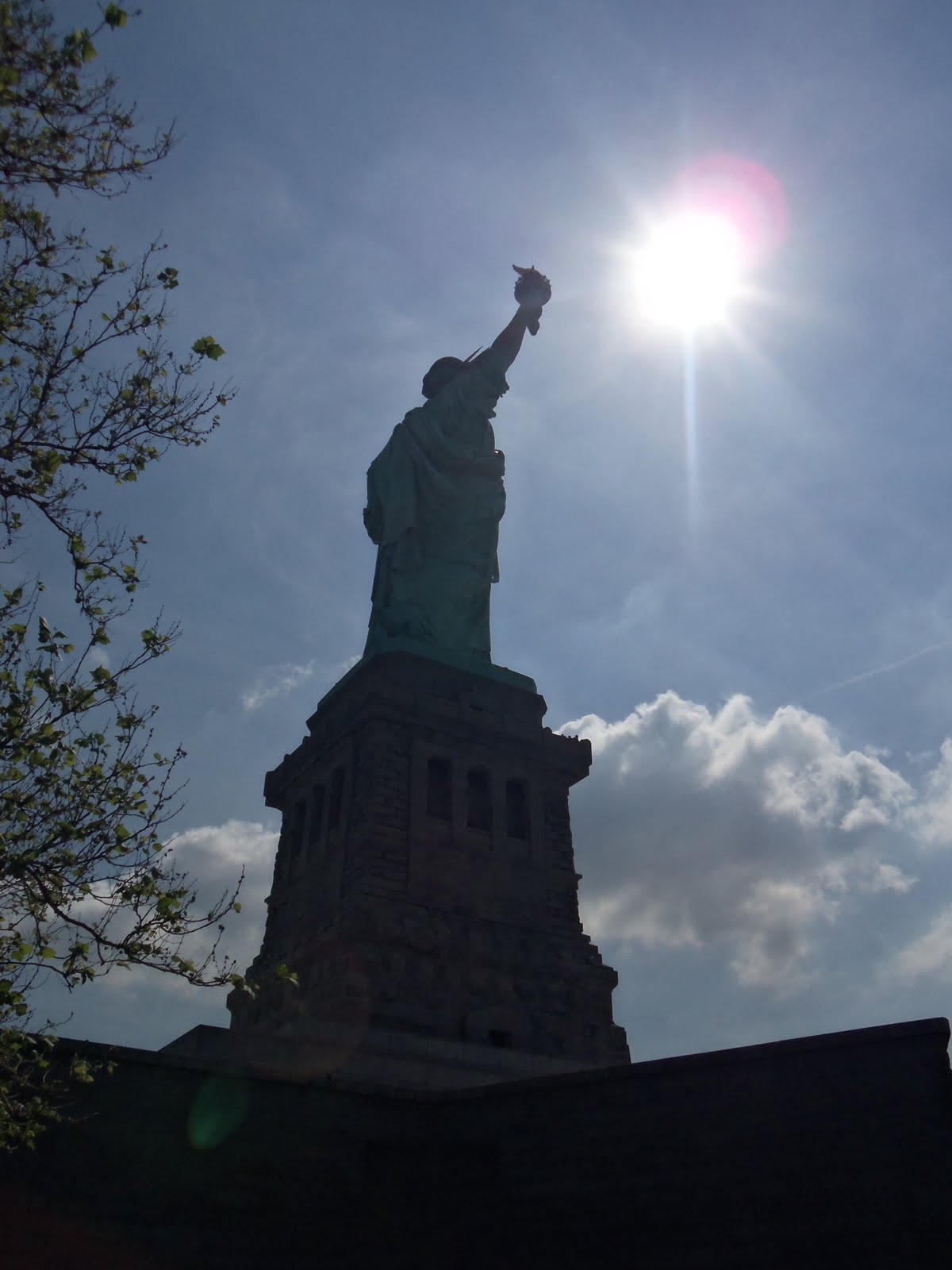
The Statue of Liberty


The Empire State Building (We did not go up to the top because neither of us wanted to pay $25 to ride an elevator but it was pretty from the outside.)


Phantom of the Opera on Broadway at the Majestic Theatre.

Saturday, May 21, 2011

So much for a mud hut in Africa

On Monday Charles Beeker, the professor I'm working with, told me that a TV show wanted to interview him, me, and a couple of other people about the work that we have been doing. I honestly thought he was joking until the next day!

It didn't really hit me until Wednesday morning when we left at 4am from Bayahibe to the capital. I was in the back seat typing a letter to the Ministry of Environment, whom we had a meeting with later that day. We pulled up to the station, got our make up done, and walked on to the set.

Of course, I was really nervous. Then I found out that the show would be live, so I got a little more nervous. Then I found out that it would not only be playing here in the DR, but also in parts of the US and in Europe, so then I was super nervous!!!! Oh yeah, and I forgot to mention that it was all in Spanish.

In the end, I think I did really well. I answered about six questions. They are going to send us copies of the tape.

On another note, go to iu.edu to see an article about what we are doing. It is currently the "Spotlight" article. (Yes that is me as the "scientific diver".) When that gets taken down, you can go to...
http://newsinfo.iu.edu/news/page/normal/18401.html.


When I joined the Peace Corps, I never expected to be doing things like this. I feel really blessed to be a part of this project.

Wednesday, February 2, 2011

Living Museums

I will be extending to Bayahibe to work on the Living Museums project, which was created by Indiana University and USAID. It will extend for three to six months but not sure exactly the time length.
They need someone to run checks on three Living Museums project sites: Guadalupe, Morales, and Captain Kidd. At each site they want to check the following things every two to three months.
1. The three sites are ship wrecks with items such as cannons, anchors, etc. some of the items they found there and some of the items they placed. They need to check if the items are still there and if there is any damage to the items.
2. Some of the items have biology or soft coral growing on them. For example, one cannon at the William Kidd wreck has two sea fans at the end of it. They need to check this biology, if it is still there or if there is new biology and the health of the biology.
3. At the William Kidd wreck there are two types of endangered coral, Staghorn and Elkhorn. They need to make sure that the coral is still there and is healthy. Also, if there are any pieces of live coral that we can save, we received training in this procedure. With two zip ties, we put broken off pieces of Elkhorn coral to an Elkhorn coral base. If done correctly the two will grow together and become one coral and continue to live.
4. Also, we would check on any other damage at the site. For example, any anchor damage or damage to the buoys, and any signs of overfishing.

The thing that I am most excited about is saving the endangered coral. Also, they would like me to work on community outreach to get the locals involved. However, we are still making plans and arrangements about what I will specifically be doing.
Last month we did training for checking and maintaining the sites. Also, how to zip tie the coral together…


Friday, December 17, 2010

MERRY CHRISTMAS!!! FELIZ NAVIDAD!

When I came home in September, I got one question a lot: What exactly do you do? My answer was always the same: That’s a good question!
That is because it depends on what I have going on at the time. However, I have some specific projects that I am almost always working on. So, I decided to update y’all on my projects so that y’all can understand a little better what it is that I do do…
1. Brigada Azul – I started the environmental youth group, Brigada Azul, in October. The original Peace Corps club is Brigada Verde, but because most everything we are going to be working on involves the ocean, I decided to call it Brigada Azul. So far we have done a few things. We painted a world map in the school and fixed-up some other murals and I took some youth to two different conferences. A health volunteer brought her youth to Isla Saona to have an “intercambio”. We gave them a speech on trash, they gave us a speech on sex ed, and we had the local doctor talk about Cholera. By the end of the year, we will do a beach clean up, some recycling activities, and take a trip to Bayahibe to see the other side of the park, the caves with Taino drawings.
2. Vendor classes – There are two jobs in Mano Juan, fishing and vending. The vendors are the people that sell small crafts and jewelry to the tourists on the beach. I am the coordinator for the vendors to get classes from an organization called Infotep. It sounds pretty easy, but what makes it difficult is where we live and having no public transportation. We always went through a specific tourist group that has about 10 workers living in Mano Juan. In July when we started, it was very difficult to get the transportation situated, but it’s gotten easier because the tourist company decided that they want to join the class. So, they provide the transportation regularly now. So far we have done classes like: basic accounting, marketing, job security, sanitation in cooking, etc. In December we’ll have a big graduation, and make a list of the classes they want to do the next year.
3. Lionfish – The lionfish is an invasive species of fish that migrated to the DR (and the Caribbean in general) from Florida. They escaped from an aquarium in Florida during a hurricane in the early 1990s, and have been migrating south ever since. They are striped, usually white with black, red, or maroon, and usually can grow to about a foot long. The problem with the lionfish is that it is one of the most venomous fish on the ocean floor and very aggressive. They have 18 venomous spines and use them against predators. For hunting, they work in groups cornering their prey, and then shallow them whole. In the Caribbean, because they’re not native here, they have no natural predators. And, because they reproduce very quickly, lionfish are becoming a plague and are rapidly killing the native fish that the fishermen live on fishing. Though they can’t kill a human, if one of their spines sticks you you’d feel it for a while.
Mid-August, I gave the fishermen a speech all about the lion fish, and was surprised how receptive they were. In October, I tried the fish (it is edible after you cut off the spines and head) with a fisherman and his family, and we all liked it.
Now one of the tourist company that eats lunch in Mano Juan has decided the fishermen $70 pesos for each pound of lionfish to feed their clients. So hopefully this will create a small market and then the fishermen will have more motivation (making money) to hunt the lionfish. Also, in January, we are going to have a huge fishing (for lionfish) competition in Bayahibe with the organization, Reef Check, and then afterwards prepare the fish for the restaurant owners. The hope is that they like it and put it on the menu. If this happens it will create a bigger market and a huge motivation for the fishermen to kill the lionfish.
4. English classes – I’ve been doing English classes ever since I got here and they are still going strong. I still teach two classes Monday through Friday in the school, and one adult class in the evening Monday through Thursday.
5. Marine Interest Group – I am the president of a Peace Corps club called the Marine Interest Group. Right now we are working on various projects. One is creating an educational manual for kids (through Brigada Verde) about issues that effect the coastal parts of the DR. Another is working with Reef Check to check and manage some coral reefs in the DR. Also, we just made a new contact that I’m very excited to work with. It’s called Living Museums in the Sea and is a project by Indiana University and USAID. Basically they set up paths of artifacts (some found and some placed) in the sea about a specific event or area. For example, in Isla Catalina they have one on the William Kidd wreak with canons, ship parts, etc. Then, tourists can scuba dive down and follow the path of artifacts learning more about the event. Indiana University would like to check on the reefs AKA museums every two or three months to make sure that the items are fitting in well with their environment and also make sure that they are not affecting the surrounding corals. However, IU can only come about twice a year. So they need man power to do the dives. IT and USAID will provide training to do the job, and then after that we will dive every two to three months to manage the sites.
I hope that this explains a little better about what I’m working on. If you have any questions, comments, or would like more information, please email me.

Sunday, November 7, 2010

Cholera and Tomas

The past week and a half has been one crazy trip…

On Wednesday, October 27th, I got a call from the safety and security officer. She told me that we would be having a Cholera training, because of the outbreak in Haiti, on Friday so I needed to head in to the capitol ASAP. I packed my bag and headed in Thursday morning. The session on Friday lasted two hours…

Cholera is a bacteria that enters through the mouth. It makes you throw up and have extreme watery diarrhea. Without treatment, young and old people usually die within two to four hours, and a normal, healthy adult usually die between 24 to 48 hours.

They predict that cholera will enter the Dominican Republic soon, maybe even sooner due to the hurricane. Also, they have no idea when the outbreak will stop; it depends on how quickly they can get it under control.

During the training, they announced that there is a strong hurricane out in the Caribbean Sea, and that we needed to call in on Monday to find out more information. On Saturday morning, I headed out to Saona. I was going to have a day camp with my friend, Laura, a health volunteer that lives in La Romana and her jovenes. I sent Laura and one of her kids off in and boat and finally, an hour later, boarded a boat with the remaining three jovenes to head to Mano Juan. Just then, the safety and security officer called me and told me that I should not return to Saona till Monday, when we knew more about the hurricane. “Bueno!” I told her the situation, and she said go ahead but be on the first boat back in the morning.

We had a great time in Saona. Our jovenes got to mingle but also learn together. We gave her group a trash charla and she gave out group a charla about sex ed. Then, we gathered the community together to have a cholera charla.

Then Sunday morning, we chipped in with a couple of community members to get a boat to take us to Bayahibe at 7am! I stayed in La Romana on Sunday night and Monday headed into the capitol. Then we learned about the potential Hurricane Tomas that was currently stalking Haiti in the Caribbean Sea. We were being consolidated in the capitol until further notice.

Then began five days of being consolidated in the Barcelo Lina, a really nice hotel, in the capitol. For two days straight the sky was dark gray, and we had high winds and rain. We were safe, though, up in the hotel. The Peace Corps picks the hotel depending on back-up generators, water, building structure, and location.

The first day, it was really fun because we were all together; however, as time passed and we ran out of things to do…we got more and more bored.Thankfully though, today, Sunday, the consolidation was lifted and we can go back to out sites. I’m really excited to get back because I really haven’t been there in 11 days!

Sunday, October 24, 2010

Brigada Verde

At the beginning of October, I started the youth group, Brigada Verde. Brigada Verde is a Peace Corps youth group that was developed to teach kids about the environment. We did our first charla on trash on the October 3rd. We learned the Three R's of trash: reduction, recycling, and re-utilization; and we are doing trash activities. This next week we will do a beach and town clean-up. I hope that we can get the community involved, too.

We also did a map mural in the school. To teach the kids geography and to have some fun painting. They got really into it and we finished in three days.


This past weekend (October 22-24th), I traveled with two of my youth, to Sabana de la Mar for the East Conference. It was held in "Los Haitises" which is a National Park. It was a great learning experience for them, and they also meet a lot of new friends from all over the east.

The last weekend of October, we are going to have a health volunteer and a few of her youth come out and do an "intercambio". They are going to give some sex ed charlas and we are going to give them a charla on basura (trash). We are also going to play soccer and have a Halloween party! After that we will have November for geography class (use the map) and the National Brigada Verde Conference the second weekend of November.

Sunday, August 22, 2010

Pictures

There are now some pics of Peru on flickr! (See link on the right hand side). And there's even more to come!

Friday, July 30, 2010

Peru: Part 5 - The "Poor Man's Galapagos"

Next we headed out to the beach town of Paracas. Of course it was to cold to swim, but it was not why we went there. Paracas is the home of the Islas Ballestas, also called the poor man’s Galapagos. There you can find flamingos, sea lions, penguins, dolphins, and 250 species of birds.


This was our guide. He was very knowledgeable and funny.


Also, there is the mysterious Candelabra (Google Paracas Candelabra). This three pronged symbol in the sand is huge and sits on the Northern face of the Paracas Peninsula. The origins are still unknown.

Peru: Part 4 - Chivay

We were going to see the condors fly and had to stop in a small town called Chivay. It didn’t look like much, but it was in the guide book. It said that just outside of town was a natural hot springs. We arrived in Chivay about 10am the morning and our bus did not leave until 3pm so we decided to check out the not springs. When we got there, there was a sign that said zip-lining which we both had never done so we decided to ask how much it was. It was really cheap so made the instant decision of going zip-lining before the hot springs. The zip-lining was actually over a shallow part of the Canon de Calca, the second largest canyon in the world. The zip-lining was a little scary at first but extremely fun!


Afterwards we headed to the natural hot springs to relax. Hot was an understatement! Then we headed back to the bus stop to wait for the bus.

It was about 2:30pm when the security told was to see the condors we would have to pay a fee. When asked how much, he said $35 dollars!! It was super expensive to have a maybe chance at see them, so we decided to stay in Chivay for the night. Thank goodness, we did the day trip of zip-lining and hot springs or the day would have been a waste.

Peru: Part 3 - Lake Titicaca

Lake Titicaca is a big lake between the Peruvian-Bolivian border. Half of the lake is considered Peru and the other is Bolivia. It is the largest lake in South America but that’s not what makes it special; it is because a floating reed plant, called totora, grows in the lake and no where else in the world. The root floats and a reed like plant grows straight up out of the water.


The people cut the reed and put layers upon layers of the reeds on the floating root. That way it becomes a floating island…


The people use the reed to make their houses, tools, to cook, and boats…


It was interesting to see the similarities and differences between the life and people on Lake Titicaca to my community. Tourists essentially do the same things at the two locations. They come in on a boat, walk around the community, look at the people’s houses and their way of life, the tourists are then hassled to buy little trinkets, they take million pictures, and then they leave. It was interesting to be on the tourist side of it and see it from their perspective.

Peru: Part 2 - Machu Picchu

Well we woke up super early and headed to the bus stop. We were told to get there an hour before the bus leaves so that we could get to go to Wandu Picchu. From this overlooking mountain, you can get great pictures of Machu Picchu, but only 300-400 people are allowed up each day. Well, we turned the corner to the bus stop and were shocked at an enormous line! We were not sure if we were in the cut or not, but waited an hour and hoped. Then the line finally started moving and we made our way up the steep mountain on tour buses. After, we waited for an addition 30 minutes to actually get into Machu Picchu and were told when we got to the entrance that Wandu Picchu was full!

A little disappointed but still excited to be at Machu Picchu, we went in to explore. About after an hour of exploring, we found a trail that was called Mount Machu Picchu and decided to go up it a little ways. We found a little hut with a worker and asked him about the trail. It was actually twice as high as Wandu Picchu and you could not only see Machu Picchu but also the tops of the Andes. We decided to climb it. Due to being out of shape and at a really high altitude, it was really hard but really worth it…


View from Mount Machu Picchu


This was part of the trail up Mount Machu Picchu. Narrow stairs beside a straight drop!


Wednesday, July 28, 2010

Peru: Part 1 - Lima and Ica

I flew into Lima, the capitol of Peru, on Wednesday, July 14th for my long-awaited vacation. I meet my friend, Jolly, there who has been traveling in South America for almost a year. Over the next two weeks, we traveled non-stop all over the southern part of Peru and did some really crazy things. We had so many adventures that I just can't squeeze them all into one blog... I was really tired the first day so we just hung around the hostel...which was actually pretty interesting because it was a mansion turned hostel. There was huge painting and strange sculptures all over the place. The next day, we headed out to the flea market because I had to buy some warmer clothes. My DR beach wear was not going to cut it on the top of Machu Picchu. I ended up buying gloves, a hat, a jacket, and warm fuzzy pants...all for under US $20! Then on the way back to the hostel, we ran into a protest. There were a long line of people marching down the main street flanked with cops with riot equipment on. It was a peaceful protest, but we decided to get off the main street just in case, but not before getting some getting a couple of pics...


Then we grabbed our bags and headed on the bus for the main bus station. I was sitting in one seat with my huge bag when a man and woman came on. The woman sat next to me so I scooted over toward the window and the man stood next to her. He was looking at her pretty intently but I didn't think anything of it because I thought they were together. I turned my head, heard a popping sound, and turned back to the couple just in time to see him run off the bus. The guy, obviously now that they did not get on together, had pulled her necklace off her neck and taken off the bus before the door closed. It was so fast; I can't believe that I had my head turned for just a second and missed seeing him doing it! She wasn't hurt just a little embarrassed while explaining that the necklace wasn't anything "oro ni plata" gold nor silver, just an old plastic cross necklace. The guy had obviously saw her necklace and thinking it was worth something, followed her on the bus to steal it. It was a crazy thing to witness.

Sandboarding in Ica: We headed down to Ica about a five hour bus ride south of Lima. We got there that night and I tried “Salchipapa” for the first time. It is French fries, with chicken, and a green salad on top. Then they put sauces; ketchup, ranch, mayo, and a spicy sauce; all on top and mix it all together. It sounded a little gross, it looked pretty gross, but it was actually pretty damn good! I noticed during the next two weeks that Peruvians liked to mix things you wouldn’t expect to eat together a lot and it was usually surprisingly good. The next morning we headed for the desert to go on dune buggies and go sand-boarding. That’s right sand-boarding! It was really, really fun and so cool to just be in the desert.


Monday, June 28, 2010

Sea Turtles


For the past two months, I have been busy learning so much about Isla Saona: the history, the people, their way of life, potiential projects, how tourism works out there, the special laws (because it is a national park), and exploring the beaches. The best project that is on the island is the sea turtle conservation project…

All seven types of sea turtles are endangered species. There are three types (Hawksbill, Green, and Leatherback) of sea turtles that come to the south side of Isla Saona to lay their eggs. Each female turtle climbs up on shore during the night, digs a hole using it’s flippers, waits, gives birth to about 100-150 eggs, and then swims back out to sea. During a season, a female turtle can do this ritual three to eight times. The gestation period depends on the type of turtle, but after about two months, the baby turtles hatch during the night, break through to the surface, and follow the light (the moon reflected off of the water) to the ocean.

There are two times when the baby turtles are very vulnerable to predators (lizards, birds, crabs, etc.). Once when they are still in the eggs after the mother leaves (sometimes sand is washed away by high waves and the eggs are exposed) and, or course, when the baby turtles are crawling to sea.

A man named Negro runs a one man operation in Mano Juan to help the survival rate of the sea turtles. He has two main goals (1) population growth and (2) a census (monitoring how many baby turtles make it out to sea). Negro goes out during the night, collects the eggs from the shore, and brings them back to the center. He buries them in sand in a cooler, and marks the cooler with the type of turtle, how many eggs there are, the date he collected them, and the beach where he found them. Then he waits until they hatch and when they are ready to go to sea, he takes them back to the beach where he found them and lets them go out to sea.

However, Negro isn’t just fighting against crabs and lizards, he’s also fighting against one of the worst predators in the world…man. Negro tells me that the people of Mano Juan understand and don’t bother the eggs. However, people come in during the night from Bayahibe and La Romana to steal the eggs and also capture the female turtles. Turtle eggs are a delicacy to eat and sometimes are also sold to tourists. The turtles are captured to sell or to kill for their shells (to make jewelry and crafts) and for their meat. He says that because it is only him running the operation it is hard to catch the people, and that it’s very sad when he gets to a beach and the only thing he finds are dug up nests.

Even though it is inspiring to see Negro get so passionate about the project and very cool to know that there is such a project, it is very sad to know that men are continuing to not care about the species and only care about making a buck.

I really want to learn about the project more and how I can help. I will keep you updated.

Tuesday, May 11, 2010

Does a coconut a day keep anything away?


I have now been at my site for three weeks and have been having an interesting experience so far.

The helicopter ride was amazing. A little scary at first because it was really shaky, but the view was amazing.


I started working on my diagnostic (going house to house with community members to meet people. Also, I started teaching English in the school and one class to the adults. Everything has been going well so far. I have had one meeting with the group I’m going to be working with, Junta de Vecinos, and they sound very excited about working. I have yet to see a turtle but there are plenty on congrejos or crabs and one day a couple of dolphins came close to the shore.

In two weeks, I will present my diagnostic at the one year conference, and decide which project to undertake.

As for communication, there is internet at the restaurant next door to my house, but the owner for some reason doesn’t want us to use it. The “centro de llamada” or call center is a really tall tree that you have to climb to the very top. I haven’t gotten to the top yet, but 4 kilometers away I get a little bit of service.


Centro de llamada